
As a PPC agency, it’s easy to see from the outside what our clients are struggling with when they come to us.
Take a sneak peek at the signs that it’s time to outsource your PPC management:
Video Transcript
I talk to people every week about why it might be time to hand over their paid traffic management to us, the experts. Something many of them struggle with is a reluctance to let go of overseeing the accounts themselves.
While it’s true that if your campaigns are small or just starting out, we recommend that you take the reigns in those early times, but there comes a time to relinquish control and choose a PPC agency (Moz has a helpful article on this topic). It doesn’t have to mean an admission of defeat. On the contrary, it means you’ve done something right!
Let’s look at some of the reasons you might want to hand things over.
In-House vs. Agency vs. Freelancer: Which PPC Model Actually Works?
Before deciding whether to outsource your PPC, you need to understand what you’re actually choosing between. Most business owners frame this as a binary — “do it myself or hire someone” — but there are three distinct models, each with a completely different cost structure, risk profile, and performance ceiling.
An in-house PPC manager is a full-time employee dedicated to your ad accounts. They know your brand deeply, sit in your meetings, and respond to changes immediately. The catch is that one person can only know so much — they typically master one or two platforms, rarely have time for proactive testing, and when they leave, they take all institutional knowledge with them.
A PPC agency brings a team: a strategist, a copywriter, a data analyst, and often platform specialists. You pay for access to that collective expertise, cross-industry benchmarks, and redundancy if one person leaves. The tradeoff is that you’re one of many clients, brand immersion takes time, and communication runs through an account manager rather than directly to the person touching your campaigns.
A freelancer sits in the middle — typically one specialist charging less than an agency but more flexible than hiring in-house. They work well for single-platform accounts with predictable volume. The risk is the same as in-house: one person, one point of failure.
| Factor | In-House Manager | PPC Agency | Freelancer |
|---|---|---|---|
| Monthly Cost | $4,000–$8,000 (salary) | $1,000–$5,000 + % of spend | $500–$3,000 flat |
| Platform Expertise | 1–2 platforms | Google, Meta, Amazon, Bing | 1–3 platforms |
| Scalability | ❌ Limited | ✅ High | ⚠️ Medium |
| Brand Knowledge | ✅ Deep | ⚠️ Takes 1–3 months | ⚠️ Variable |
| Turnover Risk | ⚠️ High | ✅ Low (team backup) | ❌ High |
| Response Time | ✅ Immediate | ⚠️ 24–48 hrs typical | ⚠️ Variable |
| Best For | Enterprise, $500K+ spend | Growth-stage, multi-channel | Small budgets, 1 platform |
The Real Cost of Managing PPC In-House (Most Businesses Get This Wrong)
The most common mistake business owners make when evaluating in-house PPC is comparing the agency fee to the salary alone. That comparison always makes in-house look cheaper — and it’s almost always wrong.
A PPC manager earning $65,000 a year costs you roughly $5,400 a month in salary. But that’s not what they cost. Add employer payroll taxes (7.65%), health insurance, paid leave, and any performance bonus, and you’re already at $7,000–$8,000 per month before they’ve opened a single campaign. On top of that, a professional PPC manager needs tools — keyword research software, bid management platforms, A/B testing tools, and reporting dashboards — that typically run $300–$1,200 per month depending on account complexity.
Then factor in recruitment. The average time-to-hire for a PPC specialist is 6–8 weeks, and job board fees, recruiter commissions, and onboarding time add up to roughly $5,000–$10,000 per hire. Amortized over a year, that’s $400–$800 per month in hidden hiring cost — before you account for the revenue lost during the gap between one manager leaving and the next one reaching full productivity.
The table below shows what in-house PPC management actually costs versus what most businesses think it costs.
| Cost Category | Monthly Estimate | Commonly Overlooked? |
|---|---|---|
| PPC Manager Base Salary | $4,500–$7,500 | ❌ No — this is the only number most people see |
| Payroll Tax + Benefits | +20–30% of salary | ✅ Almost always missed |
| PPC Tools & Software | $300–$1,200 | ✅ Frequently missed |
| Training & Certifications | $100–$400 | ✅ Frequently missed |
| Recruitment (amortized annually) | $400–$800 | ✅ Almost always missed |
| Lost Revenue During Ramp-Up | $500–$2,000 est. | ✅ Almost never counted |
| Total True Monthly Cost | $7,000–$13,000/mo | vs. agency retainer at $1,500–$5,000 |
7 Signs You Should Outsource Your PPC Right Now
Most businesses wait too long to outsource. By the time they make the call, they’ve already burned months of budget on a stagnating account, lost ground to competitors who moved faster, or watched a key employee walk out the door with everything they knew about the campaigns.
The signals below are concrete and measurable. If you recognize three or more, the math on outsourcing almost certainly works in your favor.
Your cost per acquisition has risen three months in a row. This is the clearest performance signal there is. A rising CPA in a stable market means optimization has plateaued — the person managing the account has run out of levers to pull. A fresh team with cross-account benchmarks will typically find headroom within the first 60 days.
You’re spending more than 10 hours a week on campaign management. As a business owner or marketing director, your time has a dollar value. At 10 hours a week, you’re contributing the equivalent of a quarter-time employee to PPC alone — time that isn’t going to product, sales, or strategy. A specialist does in two hours what takes a generalist ten.
You haven’t run a single A/B test in the last 60 days. Ad creative fatigues fast. CTR drops quietly over weeks, and most self-managed accounts don’t catch it until spend efficiency has already deteriorated significantly. Systematic creative testing is the first thing that gets deprioritized when someone is managing PPC alongside other responsibilities.
You’re only running ads on one platform. If your competitors are on Google, Meta, YouTube, and Bing while you’re running Google Search campaigns only, they are capturing your audience at every stage of the funnel while you’re only showing up at the bottom. Expanding platforms requires both the expertise to set them up correctly and the bandwidth to manage them — which typically means it’s time for a team.
Your average Quality Score is below 6. A Quality Score under 6 means you’re paying a cost-per-click premium compared to better-optimized accounts in your auction. Google rewards relevance — tighter ad groups, stronger landing page alignment, and higher CTR all drive Quality Score up and CPC down. Recovering a poor Quality Score is a structural project that requires dedicated time and expertise.
You cannot explain your ROAS by channel. If you know your total ad spend and total revenue but can’t break down performance by campaign type, platform, or audience segment, you don’t have attribution — you have aggregated data. Without channel-level visibility, every budget decision is a guess. This is a systems problem that agencies solve on day one of onboarding.
Your PPC manager just gave notice. This is the highest-urgency scenario on the list. When an in-house specialist leaves, campaigns don’t pause — they continue spending while performance silently degrades. The 6–8 week hiring gap, followed by a 4–6 week ramp-up for the new hire, represents months of suboptimal performance. An agency can be onboarded and operational in 1–2 weeks.
| Warning Sign | What It Signals | Urgency |
|---|---|---|
| CPA rising 3+ months in a row | Optimization has stalled — fresh expertise needed | 🔴 High |
| 10+ hours/week spent on PPC | Owner time cost exceeds management fee | 🟠 Medium |
| No A/B tests in 60+ days | Creative fatigue is silently eroding CTR | 🔴 High |
| Running ads on only one platform | Competitors are capturing your audience elsewhere | 🟠 Medium |
| Average Quality Score below 6 | You're overpaying per click vs. optimized accounts | 🔴 High |
| Can't explain ROAS by channel | No attribution = every budget decision is a guess | 🔴 High |
| PPC manager just resigned | Institutional knowledge walkout + 3-month performance gap | 🔴 Critical |
Account growth - too big to manage
So you started out on a shoestring budget and only had 2 or 3 campaigns to start. Then you added in some new PLAs. You heard about the glory of remarketing, and started some remarketing campaigns. Someone sent you a blog post on the importance of negative keywords, so you’re combing through your search queries to add those in manually.

The list just goes on and on, because there’s just so much you can do inside your accounts as they grow and change.
You want to try something new with paid traffic
Maybe you saw a YouTube video on Advanced PLA structures or want to start retargeting to Facebook to capture a new audience. Did you hear about call tracking and how that can help you more accurately track conversions? Is it time to expand to Bing, Instagram, or test the waters on LinkedIn?

There are limitless avenues for you to take your paid search – do you know how to implement all these new ideas you have for your campaigns?
Your competition is growing
It’s so easy to start an ecommerce store these days. When you first started out, you were the only one selling at home solar panel kits, and now there’s 6 million Google search results for your product. What are you doing to get ahead of your competition?
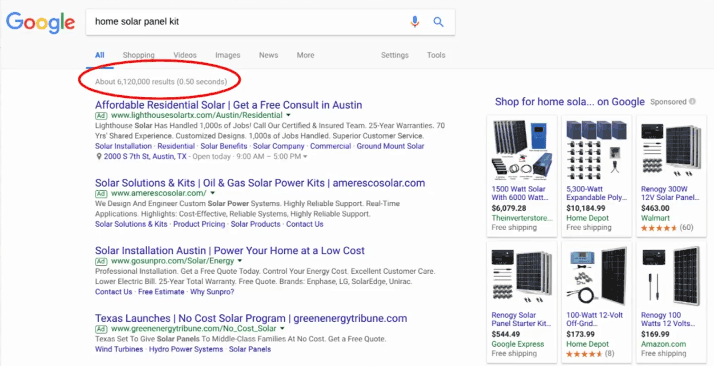
Beyond having an excellent landing page and working on your SEO, you need to be on top of your PPC game and have a complete strategy for staying ahead of your competition and in front of your customers.
You don’t have the time to manage your own PPC
We know better than anyone – good PPC takes time! It’s the reason that it’s the only thing we do at Search Scientists. A well managed account takes a lot of watchful management:
- Going in and looking for new keywords
- Testing ads
- Finding negative keywords
- Bid optimization
- Looking for areas of wasted spend
- Analyzing test results
You might be at the point where the time involved is just too much. You’re out in the world running a business, talking to employees, developing a customer base, customizing your products, talking to manufacturers, and dealing with software glitches. You may be in school or working another job or walking your dog or trying to get through a lengthy novel – and just don’t have the time to properly manage all the aspects of your digital marketing accounts to keep them healthy and profitable.
Wrap-up
Whether your campaigns are getting too big to handle, you’re trying to choose some new techniques, your competition is biting at your heels, or you simply don’t have the time for it any longer, handing over your accounts to a team of proven professionals could be just the thing you need to push your campaigns to the next level and start seeing a real return on your ad budget. And you’ll have more time for all the other things in your life that you enjoy.

Are you feeling your competition close? Or is the lack of time making you think of outsourcing your PPC? Let us know in the comments below what is the most stressful part for you when it comes to PPC management.
Stay tuned for Jessica’s next installment, where she’ll go over some of the many benefits of hiring a professional to manage your PPC.
If you’re curious whether your campaigns are ready for professional management, request a proposal to find out.
