

Have you ever wanted to check that your ad is appearing in a certain state? How about a specific city on the mobile platform? Need to know if you appear on the first page for a certain keyword, but don’t want to rack up an impression? The Ad Preview & Diagnosis tool is there to help you do just that.
You can navigate to the Ad Preview & Diagnosis tool near the top of the AdWords interface, under the “Tools” tab.
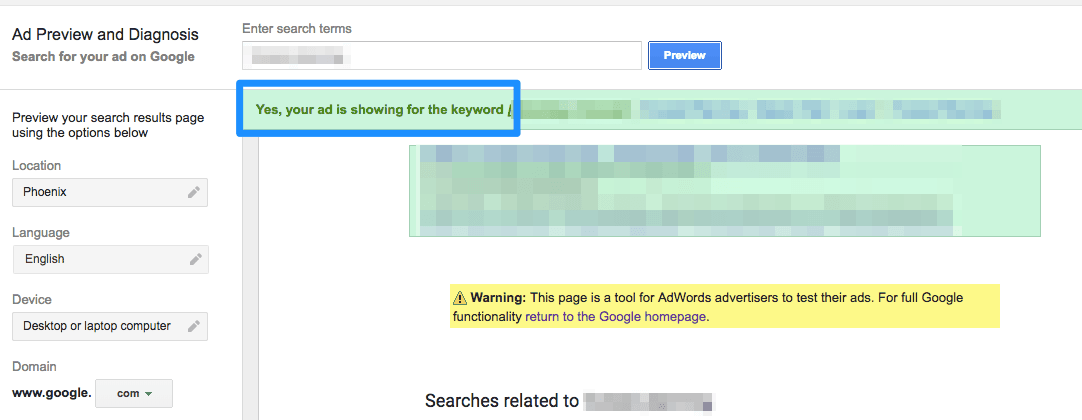
What does the tool do for you?
Among other things, you can use the Ad Preview & Diagnosis tool to:
- Check your position against other ads for your keywords. This will help you identify areas in your ad copy you can split test against current ads.
- The exact keyword that triggered your ad in a given ad group.
- Check to make sure your ads look good across multiple platforms.
It can also help you diagnose any issue you may be experiencing, such as:
- Low ranking
- Poor quality score
- Negative keywords blocking your ads

Ad Preview & Diagnosis is a helpful tool that AdWords provides you to help troubleshoot issues, as well as confirm your ads are showing properly in real time. Use it to your advantage!
Why Your Google Ads Are Not Showing and How to Fix It
A common issue advertisers face is simple but frustrating: their ads are not showing. The Ad Preview and Diagnosis Tool helps uncover the exact reason, often within seconds.
In many cases, the problem comes down to Ad Rank, which is influenced by both your bid and Quality Score. If your ad isn’t competitive enough, it won’t appear—even if everything else is set correctly. Improving ad relevance, refining your keywords, and aligning your landing page content can significantly improve your chances.
Budget limitations are another frequent cause. If your daily budget is too low, your ads may stop showing early in the day. This can create the illusion that something is broken when, in reality, your campaign has simply run out of funds.
Sometimes the issue is more subtle. Keywords with low search volume may rarely trigger ads, while overly narrow targeting can restrict visibility to such a small audience that impressions become inconsistent. There are also cases where ads are disapproved due to policy violations, which completely prevents them from showing.
What makes this tool especially valuable is that it doesn’t just tell you that your ads aren’t showing—it explains why. This makes it one of the most practical solutions for anyone searching for answers to “why my Google Ads are not showing” or trying to run an effective ad visibility check without damaging campaign performance.
Advanced Optimization Strategies Using the Tool
Once you move beyond basic checks, the Ad Preview and Diagnosis Tool becomes a strategic asset for campaign optimization. It allows you to test scenarios that would otherwise require time-consuming experiments or guesswork.
One of the most effective uses is analyzing how ads appear in different locations. By switching regions, you can immediately see how messaging, competitors, and positioning change. This is especially useful for businesses operating in multiple markets, where localized messaging can dramatically impact performance.
Another powerful application is device comparison. Ads don’t always perform equally across mobile and desktop, and this tool helps you see those differences firsthand. If your ads look weaker or less prominent on mobile, it may be time to rethink your copy or adjust your bidding strategy.
The tool also works well for keyword-level diagnostics. By running multiple search terms through the preview, you can quickly identify which ones trigger ads and which ones fail due to low relevance or insufficient bids. This helps refine your keyword strategy without wasting budget on live testing.
Over time, these small insights compound. Instead of guessing or reacting to performance drops, you begin proactively shaping your campaigns based on real visibility data. That’s where the Ad Preview and Diagnosis Tool shifts from being a simple utility to becoming a core part of your PPC optimization workflow.
How to Check Ads Without Affecting Impressions or CTR
One of the biggest mistakes advertisers make is searching for their own ads directly on Google. It seems harmless, but in reality, it can quietly damage your campaign performance over time.
Every time you search and don’t click your ad, you’re lowering your expected click-through rate. Since CTR is a key factor in Quality Score, this behavior can reduce your Ad Rank and make your ads less competitive in auctions. This is exactly why the Ad Preview and Diagnosis Tool exists.
The tool allows you to check Google Ads without impressions being counted in your campaign data. It simulates a real search environment but isolates it from performance metrics. That means you can safely run multiple checks, test different keywords, and explore variations without worrying about skewing your analytics.
This becomes especially important when working with clients or teams. Instead of asking colleagues to “Google the ad,” you can rely on a controlled environment that preserves data accuracy. Over time, this protects your campaign integrity and ensures that your optimization decisions are based on real user behavior—not internal testing noise.
Another advantage is consistency. Manual searches can produce personalized or location-biased results, while the tool gives you a more neutral and controlled view. For anyone serious about PPC ad testing and optimization, this is the only reliable way to verify ad visibility.
Using the Tool for Ongoing Google Ads Troubleshooting and Scaling
Beyond diagnostics and previews, the Ad Preview and Diagnosis Tool plays a key role in long-term campaign management. It’s not just something you use when things break—it’s something you integrate into your regular optimization routine.
When scaling campaigns, small issues can quickly become expensive. A keyword that stops triggering ads, a bid that becomes uncompetitive, or a targeting setting that limits reach can all reduce performance without obvious warning signs. By regularly checking your campaigns through the tool, you can catch these issues early.
It’s particularly useful during expansion phases. When you add new keywords or enter new markets, you can immediately validate whether your ads are eligible to show. This shortens the feedback loop dramatically. Instead of waiting for performance data to accumulate, you get instant insight into whether your setup is working.
The tool also helps maintain alignment between your strategy and actual ad delivery. Sometimes campaigns look correct in the dashboard but behave differently in real search conditions. This gap between configuration and reality is where many inefficiencies hide. Using the tool regularly helps close that gap.
Over time, this approach turns reactive troubleshooting into proactive optimization. Instead of asking “why did performance drop,” you start preventing those drops from happening in the first place. For advertisers focused on scaling efficiently, this shift is critical.

